
Resilience, Brain Health, and Performance Under Pressure
The Modern Workplace Is Pushing the Brain to Its Limits
Something shifted in the way we work, and most people felt it before they could name it.
The days got longer. The inputs multiplied. Decisions that used to take a week now take an hour. The expectation of availability stopped being implicit and became structural. And underneath all of it, a quiet pressure: to perform, to keep up, to not be the one who breaks first.
This is not a motivation problem. High performers are not burning out because they stopped caring. They are burning out because they are operating in systems that were never designed for the way the human brain actually works.
The brain has limits. It has a finite capacity for sustained focus, for processing competing demands, for recovering from stress without rest. When those limits are exceeded, not occasionally but week after week, the system does not just slow down. It starts to fail.
This is not a personal failure. It is a mismatch between modern work demands and how the brain is designed to function.
The question is not whether your people are resilient enough. The question is whether the conditions you are asking them to work in are ones any brain could sustain. That is the problem this work was built to solve.
What Is Resilience? A Brain-Based Definition
Most definitions of resilience stop at "bouncing back." It is a tidy metaphor, and a limited one.
From a neuroscience perspective, resilience is the brain's trained capacity to regulate stress, recover cognitive resources, and adapt behavior under pressure. It is not a personality trait you either have or do not. It is a measurable, learnable skill rooted in how the nervous system responds to load.
Three components make up what researchers call a resilient stress response. Recognize: the ability to notice stress signals in the body and mind before they compound. Reframe: the cognitive capacity to shift perspective on a stressor and interrupt a negative loop. Reset: the physiological and behavioral practices that bring the nervous system back to a regulated state.
Together, these form a system. And like any system, it can be designed for, not just reacted to.

A Different Approach — Treating Stress Like a System
The wellness industry has spent decades telling people to slow down, breathe more, and practice self-care. That is not wrong. It is just not enough for the environments most high performers actually work in.
What is missing is not awareness. It is architecture.
When you are an engineer — which I was, before I became a neuroscientist — you do not approach a failing bridge by telling it to try harder. You look at the load. You examine the recovery mechanisms. You find the failure points and redesign the system.
That is the frame I bring to stress and performance. Stress is not just a feeling to manage. It is a system with load (the demands placed on you), recovery (how and how often you reset), and failure points (the places where breakdown becomes burnout). When you understand those components, you stop white-knuckling through hard seasons and start designing for them.
Stress is not just something to manage — it is something to design for.
There are no breathing reminders on your phone. No mandatory mindfulness apps. No hour-long meditation sessions that real people in high-pressure jobs will never do. There are practical tools, grounded in neuroscience, that take 1–2 minutes and work in the middle of an actual workday.
Related: How to Extinguish Burnout and Reset Yourself to Calm
Burnout Is a Brain Problem, Not a Motivation Problem
The research is not subtle.
More than half of the U.S. workforce — 55%, according to Eagle Hill Consulting's 2025 report — is currently experiencing burnout. Not stress. Not fatigue. Burnout.
What is driving it has shifted. According to Deloitte's 2025 Human Capital Trends research, mental fatigue and cognitive strain have surpassed workload volume as the primary burnout indicators. The problem is not how much people are doing. It is what constant digital pressure, fragmented attention, and always-on availability are doing to the brain.
The downstream costs are significant. Burned-out employees are 63% more likely to take a sick day, according to Gallup, and 2.6 times more likely to leave their organization. Across the U.S. economy, burnout costs an estimated $300 billion annually in absenteeism, turnover, and healthcare expenses. See the full research library.
This is not an engagement problem. It is not a culture problem. It is a brain design problem, and it has a systems solution.
The organizations that will outperform the next decade are not the ones that push their people hardest. They are the ones that understand how performance actually works, and build the conditions that support it.
Explore these themes further on On Your Mind with Dorsey Standish, a podcast where brain science meets real life.
How Stress Affects the Brain
Stress is not the enemy. That is the first thing worth getting straight.
When your brain perceives a threat or a challenge, the amygdala activates the stress response. Heart rate climbs. Cortisol and adrenaline release. The prefrontal cortex, which handles logic, planning, and decision-making, takes a temporary back seat. This is your nervous system doing exactly what it was designed to do.
Short-term, this is useful. Acute stress sharpens focus and mobilizes energy. The problem is what happens when it never turns off.
Chronic stress keeps the amygdala in a state of low-level activation. The prefrontal cortex stays partially offline. Decision-making degrades. Emotional regulation becomes harder. Creativity and strategic thinking, the highest-value work most leaders are paid to do, are the first things to go.
Recovery is not a luxury. It is the mechanism that makes high performance possible. Most organizations have not built for it. That is the gap this work closes.
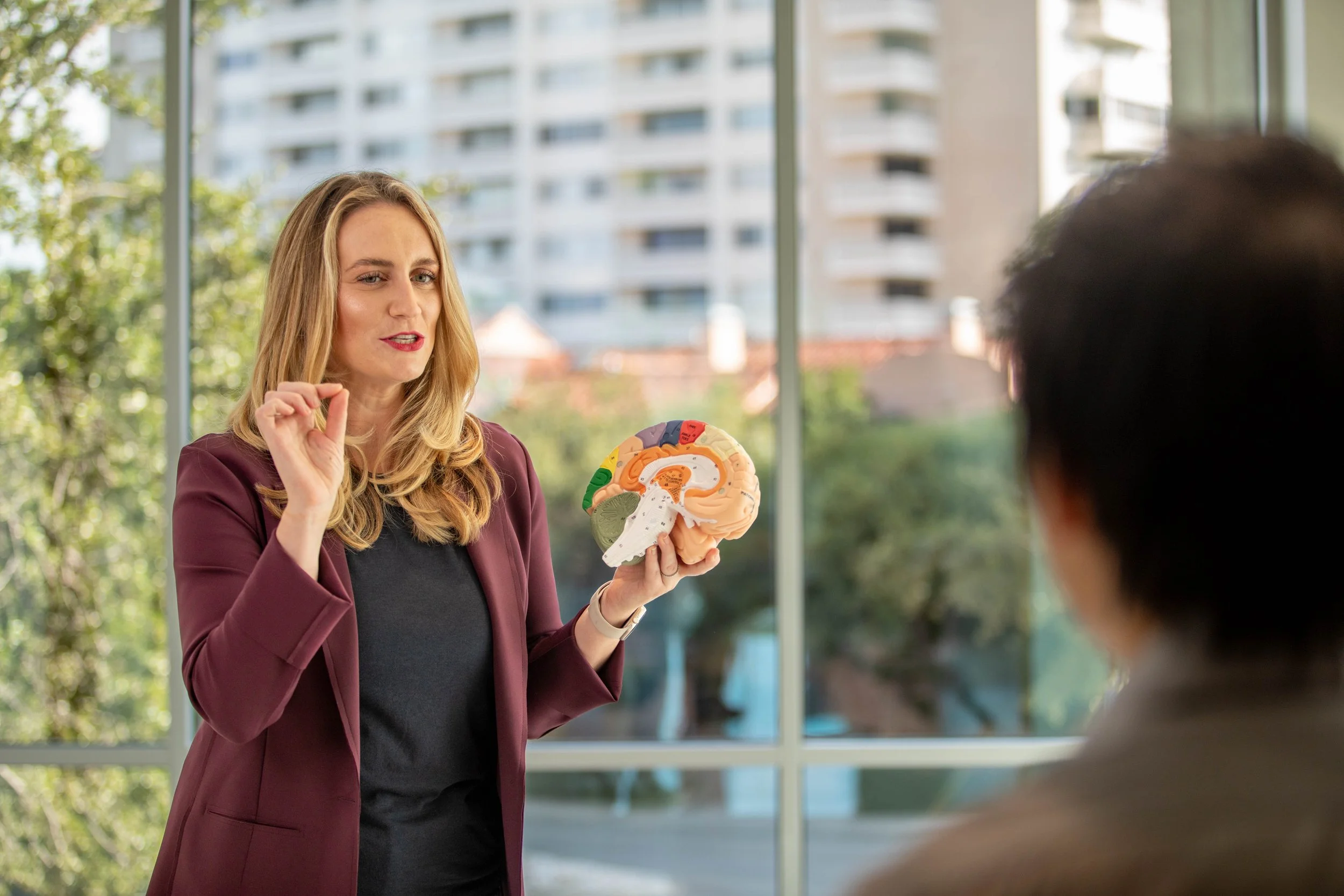
Training Resilience as a Skill, Not a Trait
One of the most persistent myths about resilience is that you either have it or you do not. Neuroscience does not support that story.
Resilience is trainable. The nervous system is plastic, meaning it changes in response to repeated experience. When people practice recognizing stress signals, reframing stressors, and using evidence-based reset tools, they are literally building new neural pathways. Recovery gets faster. The window between stressor and reaction (the space where good decisions live) gets wider.
Research shows that even 1–2 minutes of intentional regulation, repeated daily, produces measurable nervous system change over time. Not an hour on a meditation cushion. A Mindful Minute, done consistently, is enough to start.
Self-awareness is the entry point for all of it. You cannot regulate what you cannot notice. When people develop the capacity to observe what is happening in their body and mind in real time, in the middle of a high-pressure moment, they gain access to a choice they did not have before. That choice is the beginning of resilience.
Practical Tools for Stress, Focus, and Emotional Regulation
I built the Three R’s for Resilience to help high-performing teams regulate stress, recover cognitive resources, and perform sustainably under pressure. The three R’s are Recognize, Reframe, and Reset. It is a repeatable operating practice, not a personality trait. Here is what each one looks like in real life.
Recognize: Building Awareness
Most people spend hours in a stress response before they realize they are in one. The first skill is simply noticing. One of the most practical tools for building this awareness is the S.T.O.P. practice: Stop what you are doing. Take a breath. Observe what is happening in your body and mind without judgment. Then Proceed, with more information than you had a minute ago. It takes less than 60 seconds and works in the middle of a workday, before a difficult conversation, or at any moment when you notice you have drifted into reactivity.
Reframe: Shifting Perspective
Cognitive reframing means interrupting the automatic interpretation the brain makes under threat and deliberately choosing a different one. Research from the University of Wisconsin found that people who view stress as a growth signal experience significantly fewer adverse health effects from it. The stress does not disappear. The brain's relationship to it changes.
Related: Boost Work Performance with Mindful Self-Compassion
Reset: Regulating the Nervous System
The physiological sigh (a double inhale through the nose followed by a long exhale) is the fastest way to activate the parasympathetic nervous system in real time. Social connection, movement, and creativity also complete the stress cycle, which is why real human connection is not a soft perk. It is a recovery mechanism. Building a personal toolkit of 1-minute reset practices is the final piece of training resilience as a skill.
Related: How to Quiet Your Mind
What Actually Improves Performance Under Pressure
High performance is not a function of working harder. It is a function of recovering well.
That is a reframe most Type A professionals resist, because effort feels like the one variable you can always control. But effort without recovery is a diminishing return. Sleep deprivation degrades decision-making to a degree equivalent to legal intoxication. Sustained cognitive strain without regulation erodes emotional control, creativity, and interpersonal judgment.
When people build the skills to regulate their nervous systems in real time, the performance improvements are not subtle. Focus sharpens because the prefrontal cortex is no longer competing with a chronically activated threat response. Decisions improve because leaders access their full cognitive resources rather than reacting from a depleted baseline. Empathy and communication strengthen because emotional regulation is a prerequisite for both.

Case Study: Building Resilience on the Job Site — HITT Contracting
Industry: Construction / project management
The challenge: HITT Contracting operates in one of the most high-stakes, high-pressure industries in the country. Project managers and supervisors are managing complex crews, compressed timelines, and safety-critical decisions, often while navigating tense team dynamics and communication breakdowns. The firm wanted to build emotional intelligence and resilience across their leadership ranks without pulling people away from the work for extended periods.
What Dorsey delivered: A multi-session emotional intelligence and resilience training series for supervisors and project managers. Sessions focused on stress recognition, cognitive regulation, communication, and team cohesion, delivered in formats that fit a construction work environment.
Outcome: Participants walked away with practical tools they could apply immediately across communication, stress management, and team dynamics. The series had measurable impact on how leaders navigated daily challenges on and off the job site.
"Dorsey's training series had an immediate, positive impact on our team, providing valuable tools to improve communication and navigate challenges. I highly recommend this training to foster emotional intelligence and create a more supportive and effective work environment."
— Spencer Allin, Senior Project Manager, HITT Contracting
Restoring Brain Health in a High-Performance World
There is a bigger picture behind all of this.
We are living in conditions the human brain was never designed for. The pace of digital demand, the fragmentation of attention, the AI-powered pressure to produce more, faster, always: these are genuinely new. And they are having measurable effects on how we think, feel, connect, and recover.
The Blue Zones (the communities around the world with the highest rates of longevity and well-being) do not have better productivity tools. They have deeper human connection, lower chronic stress, and consistent opportunities for rest and recovery. Neuroscience and population research are pointing in the same direction: the conditions that support a long, healthy life are the same ones that support sustained high performance.
This does not mean slowing everything down. It means building smarter: designing work environments and personal practices that account for how the brain actually operates, not just how we wish it could.
How Organizations Are Applying This Work
This framework is not industry-specific, but it tends to land hardest in environments where the stakes are highest.
Construction and engineering teams deal with safety-critical decisions made under cognitive stress, often in conditions of compressed timelines and high turnover. Healthcare organizations are navigating caregiver burnout at scale, particularly among managers carrying dual emotional and operational loads. Legal and professional services firms work with professionals whose identity is often fused with output, making burnout both more likely and harder to acknowledge. Enterprise and corporate teams are managing the cumulative effects of digital overload and AI-accelerated change across large workforces.
What the work looks like varies. Some organizations start with a single high-impact keynote. Others build a training series over several months. Leadership development programs use this framework to help managers model regulated behavior, because nervous systems are contagious, and the tone leaders set ripples through entire organizations.
"Our leadership team needed a reset, and Dorsey's training delivered. The sessions were engaging, energizing, and made emotional intelligence practical, with clear ideas we're already using to navigate challenges and work better together. Leaders were appreciative of the opportunity to slow down, reflect, and move forward more aligned as a team."
— Sara Evers, Acting Director, St. Charles County Public Health
Lasting change in team wellness requires a team-centered approach. Individual apps and EAP programs can support people, but they do not shift culture. Shared experiences do.
Related: How to Be Mindful in the Workplace
Meet Dorsey Standish
I did not come to this work from a research lab. I came to it from a breakdown.
I was a mechanical engineer at the University of Pennsylvania when I first started learning what stress was doing to my brain and body, not in theory, but in lived experience. The tools I eventually found came from neuroscience and from the gradual, unglamorous work of building practices that actually held under pressure.
I went back to the University of Texas at Dallas for a master's degree in cognitive neuroscience specifically to understand the research behind what I had learned to do. But the delivery is human. Because the people I work with are not interested in a lecture. They are interested in what actually works.
Over the years, I have had the privilege of working with hundreds of organizations, including Staples, Toyota, American Airlines, Meta, Haynes Boone, HITT Contracting, and Cathay Pacific. 99% of 1,756 attendees found sessions valuable. 100% of clients would rehire.
As featured in the Dallas Morning News, WFAA Good Morning Texas, and Authority Magazine.
Learn more about Mastermind.
View Dorsey's full speaker profile at Loud Management.
Signature Keynotes and Training Experiences
Every session is tailored to the audience, the industry, and the event goals. Learn more and inquire here or here.
Master Your Mind: Mindfulness for Mental Health
Mindfulness has a perception problem. Most high performers have dismissed it without trying it, because the word conjures images that have nothing to do with their actual lives. As a result, their stress goes unregulated, their attention keeps fragmenting, and they assume this is just the cost of doing the job. This keynote fixes that through storytelling, neuroscience, and experiential practices designed specifically for skeptics and high achievers. Participants leave with the top mindfulness myths debunked, a simplified mental wellness framework built around self-awareness, and a personal action plan for 1–2 Mindful Minutes per day.
Rise Above: Rewiring for Resilience
Stress is not going away. The question is whether your people have a system for it. Rise Above delivers the Three R's for Resilience (Recognize, Reframe, Reset) through neuroscience and guided exercises that participants can feel working in real time. They leave with the full framework and a personal toolkit of 1-minute resilience exercises to use throughout the workday.
"Dorsey delivered an uplifting and highly practical session that resonated with our leaders. Her authentic connection with the audience and science-based brain health tools for managing stress and resilience made her session a standout highlight of our conference."
— Deep Westacott, VP People, Americas, Cathay Pacific Airways

Case Study: Rewiring for Resilience — Tetra Pak Global Well-Being Week
Industry: Global food technology / manufacturing
The challenge: Tetra Pak wanted their annual Well-Being Week to feel like a genuine investment in their people, not a checkbox event. With a global, distributed workforce joining from multiple locations, they needed a session that would land across cultures and contexts, deliver real tools, and leave people energized rather than overwhelmed.
What Dorsey delivered: Dorsey delivered "Rewiring for Resilience" to nearly 200 Tetra Pak team members in person and virtually as the centerpiece of their global Well-Being Week. The session combined neuroscience, the Three R's framework, and guided experiential practice.
Outcome: 100% of attendees found the session valuable. 100% wanted to hear Dorsey speak again. Inspiring, relevant, engaging, and informative each rated at 95%. Participants shared that they could not wait to pass along what they learned to colleagues and family members.
"What a sense of empowerment. We all know we should take moments for ourselves, but she just gave simple steps to create a methodology to control the chaos."
— Tetra Pak attendee
Burnout Proof: Proactive Strategies for Energy and Engagement
Most organizations respond to burnout after the damage is done. Burnout Proof is a proactive framework built around psychologist Herbert Freudenberger's model of burnout. Dorsey demystifies what burnout actually is, what drives it, and — critically — what evidence-based practices stop it before it starts. Participants leave with tools to strengthen purpose and personal agency as proactive protection, and evidence-based practices for managing stress.
Related: How to Set Mindful Boundaries
The New Humanity: Restoring Brain Health Through Calm and Connection
We are the first generation of workers to operate inside conditions our brains were never designed for. The New Humanity brings together neuroscience, Blue Zones research, and storytelling to explore what is actually happening to the brain under chronic digital pressure and AI-driven output demands, and then offers a research-backed, hopeful path forward. Participants leave with tools to reset the nervous system and strengthen real connection at work and in daily life.

Case Study: Restoring Humanity at Scale — Global Consulting Firm (Confidential)
Industry: Global consulting / professional services (client confidential)
The challenge: A global consulting firm was navigating the compounding effects of sustained client demands, distributed teams operating across time zones, and the pressure of always-on connectivity. Anxiety, exhaustion, and disconnection were showing up across regions. The firm wanted a session on brain health and human connection that would resonate globally (across cultures, roles, and seniority levels) without talking down to a highly analytical, high-performing audience.
What Dorsey delivered: Dorsey delivered "Restoring Our Humanity for Lasting Mental Health" to global audiences across the Americas; Europe, the Middle East, and Africa (EMEA); and Asia-Pacific (APAC), reaching hundreds of participants. All sessions received a 100% valuable rating. The session wove together neuroscience, Blue Zones research, and guided experiential practice, leaving participants with a sense of calm, clarity, and connection.
Outcome: 100% of participants found the session valuable. Audience engagement scores (actionable, engaging, relevant) averaged 4.9 out of 5 across both global cohorts.
"This was spot on, much needed, and right on time. Practicing the recommendations and keeping in mind that making myself a top priority is paramount. Thank you for this."
— Global consulting firm attendee (Americas cohort, Oct 2025)
What Participants Walk Away With
The goal of every session is the same: people leave with something real they can use. Not inspiration that fades by Monday. A tool. A practice. A reframe that changes how they move through the rest of their day.
Across 1,756 attendees and 45 events, participants consistently report: practical stress management tools grounded in neuroscience; emotional regulation skills usable in real time; a simplified framework for mental wellness centered on self-awareness; improved communication and empathy with their teams; and immediate applicability through 1-minute practices and a personal inner toolkit they can carry with them.
99% of attendees rate sessions as engaging, actionable, relevant, and inspiring. 100% of event clients felt their goals were met and would bring Dorsey back.
Frequently Asked Questions
What is a resilience keynote speaker?
A resilience keynote speaker delivers presentations that help individuals and teams build the capacity to manage stress, recover from setbacks, and perform sustainably under pressure. The best resilience keynotes go beyond motivation: they deliver practical, evidence-based frameworks that participants can apply immediately. Dorsey's approach is grounded in cognitive neuroscience and systems thinking, making it especially effective for high-performing, skeptical audiences in industries like construction, healthcare, legal, and corporate.
Can resilience be taught, or is it something you are born with?
Resilience is trainable. Neuroscience research is consistent on this point: the nervous system is plastic, meaning it changes in response to repeated experience. When people practice recognizing stress signals, reframing stressors, and using evidence-based regulation tools, they build new neural pathways. Resilience is not a fixed personality trait. It is a skill.
What causes burnout in high-performing employees?
Burnout in high performers is typically not caused by lack of effort. It is caused by chronic stress without adequate recovery, emotional exhaustion from sustained demands, loss of purpose or agency, and operating in conditions that exceed what the brain is designed to sustain. According to Deloitte's 2025 research, cognitive strain and mental fatigue have now surpassed workload as the top drivers of burnout.
What is the difference between resilience training and motivational speaking?
Motivational speaking is designed to inspire. Resilience training is designed to build a skill. After a motivational keynote, people feel energized, but the feeling often fades within days. After a resilience training session, people leave with a framework and tools that change how they respond to pressure over time. Dorsey's sessions are grounded in neuroscience and built for skeptical, results-oriented audiences who have seen too much wellness theater to take it seriously.
What does mindfulness actually do for high performers?
Research on mindfulness is extensive and consistent: it reduces cortisol, improves prefrontal cortex function, strengthens emotional regulation, and accelerates recovery from stress. It does not require lengthy sessions, special environments, or any particular belief system. For high performers, the most effective entry point is typically 1–2 minutes of intentional practice, enough to activate the parasympathetic nervous system and interrupt a reactive stress loop.
What does a session with Dorsey typically look like?
Every engagement begins with a pre-session alignment call to understand the audience, the event goals, and any specific challenges the organization is navigating. Sessions can be delivered as keynotes (45–90 minutes), workshops, breakout sessions, or multi-session training programs. Dorsey uses a mix of storytelling, neuroscience, and experiential exercises. Participants do not just hear about the tools, they practice them. After the session, Dorsey provides a debrief with real-time feedback data and next-step recommendations.
Can you customize for our specific audience?
Yes. Customization can include industry-specific language and examples, audience-relevant case studies, adjusted framing for leadership versus individual contributor audiences, and specific topic emphasis based on what the organization is navigating.
What results can organizations expect?
Based on data across 45+ events and 1,756 attendees: 99% of participants find the session valuable, 95% rate it as engaging, actionable, relevant, and inspiring, and 100% of client organizations felt their goals were met. The most common outcome is a shift in how teams talk about stress, from something to hide or power through, to something they have a framework for managing. That shift has downstream effects on communication, decision-making, and retention.
Resilience Keynote Speaker Based in Dallas, Available Nationwide
Dorsey is based in Dallas, Texas and works with organizations across the country, from corporate headquarters in major metro areas to construction sites, law firms, health systems, and conference stages nationwide.
Sessions are available as in-person keynotes, virtual presentations, or hybrid events. Formats include standalone keynotes, half-day and full-day workshops, breakout sessions within larger conferences, and multi-session leadership training series. For Dallas-area organizations, in-person engagements are available with the same level of customization as national engagements.
Bring Brain-Based Resilience to Your Team
If any of this resonated — if you recognized your team in the burnout data, or felt the gap between where your people are and where they could be — the next step is a conversation.
Every engagement starts with a pre-session alignment call. It is a chance to understand what is actually happening in your organization, what you are hoping to shift, and whether this work is the right fit. From there, we design a session (or a series) built around your specific audience, your industry, and your goals.
Your people do not need more inspiration. They need a system. Let us build one together.
Organizations that have worked with Dorsey and Mastermind include Staples, Toyota, American Airlines, Meta, Haynes Boone, HITT Contracting, Cathay Pacific, and dozens of others across construction, healthcare, legal, and other sectors. 100% of clients would bring Dorsey back.
To start the conversation, reach out through Mastermind here or book Dorsey directly.